

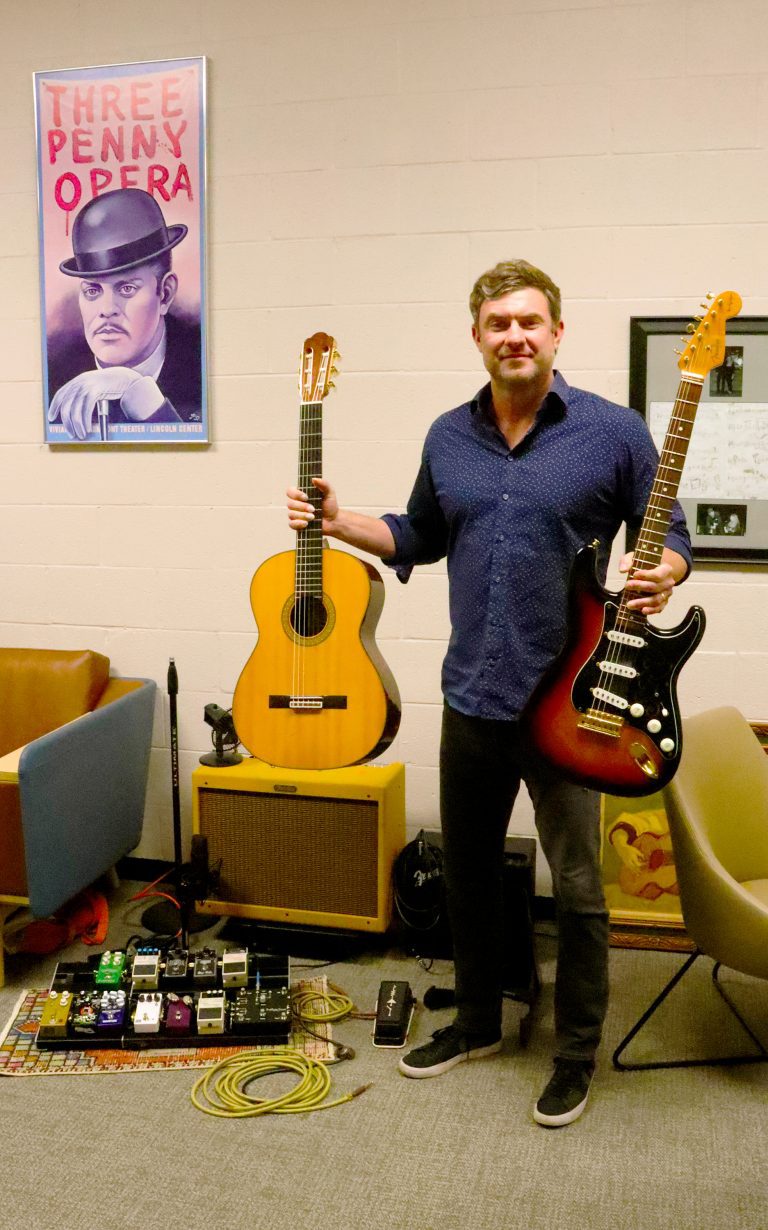
Dr. Andrew "Ryan" Book
by Frank Daniels IV || Executive Producer
Andrew Book has been a music instructor at Sandhills Community College for 15 years, and chair of its Fine Arts department for 11 of them. When he took over as chair, Book believed he could create a student experience to rival that of top-tier music conservatories.
“As a student, some of my best memories were directors of festivals hiring or inviting world-class artists that come into the university,” said Book. “They will give master classes, and then usually they would give a concert and it was always just magical.”
The classical guitarist and Appomattox, V.A. native couldn’t have known he would end up bringing those musicians to the sandhills of North Carolina. He didn’t even know he wanted to play music until he heard Dave Matthews Band when he was about 10.
“There was something about the way he played,” said Book, “and the music, the eclectic blend of the instruments, and especially the way he played rhythm guitar. I just — I became obsessed. All I ever wanted to do was learn how to play Dave Matthews. And so I did.”
He asked his mom if he could use one of her guitars. She set him up, taught him a few chords and he spent the next several years teaching himself how to play.
He eventually was able to work in some lessons. Though he said with a modest upbringing, most of those lessons were parlayed with passion, and a lot of people around him would give him lessons when they could.
Mainly, he listened and he learned, but while he enjoyed those years, he said they “ended up kind of biting” him later on, when he had to unlearn some bad habits as he continued his education.
The first fork in Book’s path was his discovery of Jimi Hendrix’s Voodoo Chile.
“It’s that story,” he said, motioning to the air, “where the hair stands up on the back of your neck and you’re like, ‘What the heck is this?’ You know?
“So then I started listening to him and really kind of graduated into that music. Then I heard Stevie Ray Vaughan, and that was it for me.”
His high school years saw his interest and inspiration follow a progression through “electric fusion blues guitarists,” like Hendrix, Vaughan and Eric Johnson.
Book found the next turn when talking to an older guitarist he respected who mentioned that Metallica guitarist Kirk Hammet said in an interview he was taking classical guitar lessons.
“I was like, ‘What’s classical guitar,’ said Book. “So he kind of explained it to me and I said, ‘Well, if Kirk Hammett’s taking lessons, like that’s the way to go.’
There was something that happened in my brain. I was like, ‘I’ve gotta learn classical guitar.’”
Though to him, it was about honing his skill as a musician, more than anything else.
He had already set himself up to attend what is now Longwood University. He was a baseball player and planned to continue that in college. For the long-term, Book was planning to follow in his grandfather’s footsteps and pursue a Psychology degree.
Then he learned that he could take his passion further.
“I found out that you could actually major in guitar,” he said. “I didn’t even know that was a thing. The next day I went over and I changed my major and I became a music major.”
Though, Book said the biggest lesson he learned was he “needed to grow up a lot.” His newfound major brought that into focus. So, he took a step back and went to a nearby community college for a year. Then he transferred to Radford University.
“ That’s really where things started to kind of open up,” said Book. “I went there specifically to study classical guitar with a teacher named Robert Trent.”
For three years he committed. After completing his undergraduate degree, he got a job at a local studio teaching kids how to play guitar — one of his favorite jobs, he said.
After a year or so, Trent called to offer a graduate teaching assistantship. Book realized that if he wanted to expand his teaching career to higher education, he would need a master’s degree, so he took the job.
That job turned into half a dozen.
“I was doing anything I possibly could to make ends meet,” said Book. “Within a year after that, Dr. Trent again came to my rescue.
He emailed me. He said, ‘There’s a job opening in Pinehurst, North Carolina at Sandhills Community College. It’s a full-time position for a guitar instructor. You need to apply for it.”
Because he was already applying for jobs around the country, an opportunity merely hours away was a blessing. A month of prep and a three-hour drive led him to an interview, and, he said, “apparently pretty well,” because then-chair Tim Haley offered him the job.
After a few years as an instructor, Haley decided to retire, and Book was promoted to lead the department.
“I probably wasn’t ready for that role at the time,” he offered. “But I was young. I was energetic. I was really highly motivated, and I had ideas for what I thought the department would be.
“I knew what kind of budgets we had and stuff like that, so I just kind of hit the ground running and went full force.”
His understanding led Book to recognize that department funding was a product of student hours, and his first priority was enrolling more students into department classes, like music appreciation. Then he and some existing staff and community members turned their attention to beginning a music series.
The value a series would bring to students was only one reason. He also felt that the community would be receptive.
“We are very diverse as a community,” he explained. “I thought the pockets of demographics that we have would appreciate high artistic performances.
“But I also knew that the people that I wanted to bring in would be something a little more special. They’re literally world-class musicians — admittedly and selfishly, they’re people that I just wanted to meet. Some of these people were my heroes.”
Like the guest for the first concert, Łukasz Kuropaczewski, who was Book’s favorite guitarist.
But, ultimately, the concert series was a reflection of the larger opportunity he saw to build on what Haley had left. Only recently removed from graduate school, Book wanted to align the college “with the four year institutions that the students were transferring into” at the time.
That includes the instructors. Book hopes the faculty in his department can “continue to not only teach and be successful with that, but also individually continue to cultivate and get better at their own personal craft.”
He believes the strength of the faculty helps support that culture, and pointed to Bradshaw Performing Arts Center and director Morgan Sills’ support of the department as another example of the college’s overall growth in the arts. The department now boasts pathways in music, visual art and, more recently, theater.
Students at Sandhills come in at varying skill levels, as opposed to a four-year conservatory, which will hold auditions and screen an incoming class to assure a similar base-level skill. Book said that the Fine Arts Department’s main mission is to take students and prepare them for that, “helping students succeed and really doing what their goal is.”
“We get non-traditional students, older students who wanna come in and do it for fun,” said Book. “Who just wanna beef up their technical or reading skills or whatever. We love them, too, but really our main type of student is the fresh-outta-high-school 19- to 23-year-old, who doesn’t have a lot of resources maybe. And is gonna take advantage of a very cost efficient program that has, in my opinion, world-class expert teachers and performers.”
Under the college’s new president, Alexander “Sandy” Stewart, there has been a renewed push for community engagement at the student level, and Book’s department is no different. You can see community performances from the choral students, and a recent agreement with Weymouth for students to open for some of its music events could grow into something more. He said it’s only in the discussion phase now, but he hopes those discussions could lead to something akin to an “arts admin” internship.
As he moves into year 12 as chair, Book feels like the department has made great strides, and he hopes to build on that momentum, growing student enrollment, supporting faculty and engaging with the community, drawing on a refrain he first heard during Stewart’s first speeches as president.
“I think this will always resonate with me,” said Book. “He said, ‘Community colleges, we meet people where they’re at,’ and that’s it. Anybody is welcome to come in here and study.
“But not only that, so it is open to the community in that way, but also, and I think especially for our programs, it is imperative to have a community presence, to sort of give back as well. That also gives our students experience in doing the thing that they’re poised to do, you know?
“So that’s really important to me, and I know to everybody else, too.”