

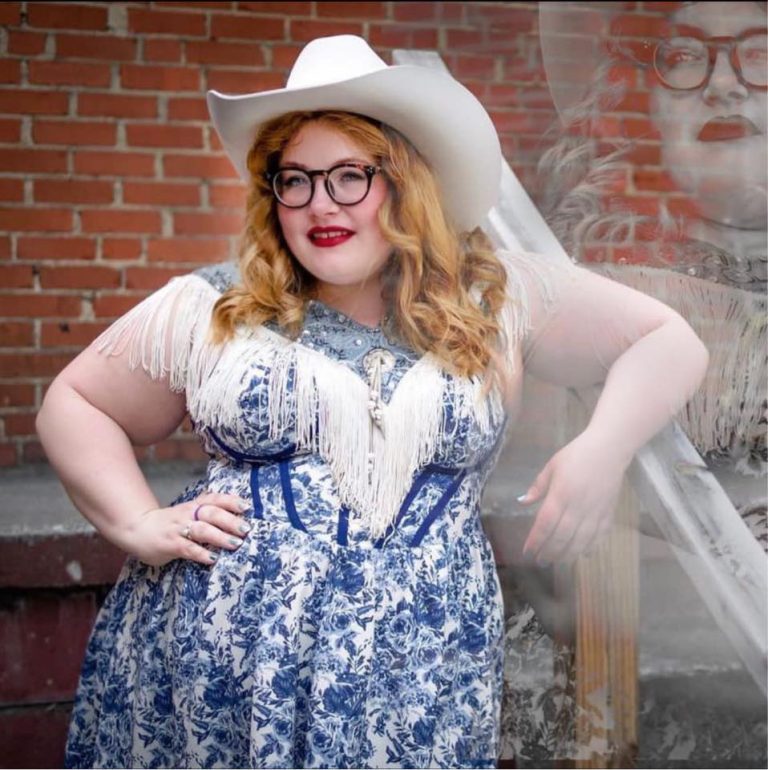
Momma Molasses
by Frank Daniels IV || Executive Producer
When she was young, Momma Molasses thought that the music industry was only filled with marketing-driven stars. It wasn’t until later that she realized the value of notes rooted deep in her own history as a Carthage, Moore County native.
“I’ve always just played like a mix of old-time, bluegrass, country, whatever,” she said. “Though, when I was younger I was definitely into the 60s and 70s, rock and folk and all those things.”
When she’s not on stage, Momma Molasses is better known as Ella Patrick. She was raised with tradition. Her family can trace its history in Moore County to the early 1800s and even earlier to the Isle of Skye in Scotland, like many of the oldest families in the county. Patrick began playing music around the age of seven or eight. She said she played music in church growing up and that she played viola in orchestra. While those environments were her introduction, her earliest memories of music in a community setting came while serving up sweet tea.
“ We always volunteer at the concession stand at the Malcolm Blue Festival and I was the sweet tea mixer,” she said. “It was actually really intense because there’s like hundreds of people, and every single person that comes must have the sweet tea.
“ I remember being a kid there, they’d always have old-time music there and bluegrass and cloggers, and I always loved that.”
And though that was a regular activity for Patrick, she was steeped in music closer to home, absorbing influences from all around. She said her uncle, John Pope, was a “walking encyclopedia” of old-time murder ballads and other folk songs, and he taught her to play guitar when she was around 11 or 12.
“he first couple of songs I learned to play and sing were Bob Dylan “Blowing in the Wind” and Merle Haggard, “Okie from Muskogee,” which is really funny for a 12- or 13-year-old to be singing that song,” she said.
Around that same time Patrick got another taste when a new neighbor from Durham moved across the street. He played Piedmont Blues, a style that grew out of Durham’s Hayti neighborhood and the influx of tobacco trading in the early 1900s.
“I remember him telling me that he had played at every juke joint in North Carolina,” she said. “He played that finger picking blues style. I remember him playing across the street to me, and he had an electric guitar that was Duke Blue for the Bull City Blues. That’s an early music memory.”
That continued from a family friend, named LouAnne Bullard, who learned guitar from a teacher in Chapel Hill that was taught by Elizabeth Cotton. As she grew she started to step into the local bluegrass circles, and found more gigs at a local saloon, called Circle M, that would host weddings and special events and held a bluegrass jam on Mondays.
“They’d have Cowboy Church on Thursdays,” said Patrick. “People would come and do kind of like country versions of gospel music. That’s something I definitely grew up with: the bluegrass band in our church and singing a lot of gospel.”
In northern Moore County, anyone in that community took notes from a legend, Roy Acuff’s one-time bass player Clyde Maness, at his weekly Tuesday potluck jam sessions at the Maness Pottery Barn on N.C. 24/27. But Patrick recalls a specific instance that helped shape her.
“Clyde Maness was always super kind to me, and we played a gig together once at McLendon Cabin,” she said. “ He always really encouraged me to play to play music.”
To that end, she attended the Swannanoa Gathering, which is a series of summer-long workshops and classes around folk music and dance in the North Carolina mountains, that’s when she chose it as a life-ling path.
“It was a songwriter week, and there was this woman there named Kate Campbell,” said Patrick. “She’s an amazing songwriter and she played with John Prine and all that stuff. She was incredible, and it opened up my eyes to there’s this whole other world of music that’s not just like the pop, glam or whatever, like meat market there is that our society just kind of like puts out there in music. And I remember being like, ‘That’s what I want to do. I want to make real music for real people.’
“ It opened my eyes to the stuff that I grew up around being culturally significant. When I was a kid, I definitely wasn’t like, ‘Oh my gosh, our church has a bluegrass band.’”
Those classes occurred on the campus at Warren Wilson College, near Asheville, and inspired Patrick to pursue her education there, where she became involved with, and minored in, old-time music and played in the bluegrass band on campus.
During that period, she branched into more professional experiences, particularly as a member of a house band at one of Asheville’s breweries, and as a fiddle player for other groups in town. Back home, a group built a stage and was starting to create a newer scene that attracted Patrick.
“In Moore County, the Jive Hive, which is in Carthage, would have bands like Sarah Shook and the Disarmers, the David Mayfield Parade and Holy Ghost Tent Revival,” she said. “It’s one of my favorite places, and I wrote a song about that whole community.”
One of those founders was William Dean, who at the time ran a coffee shop called Cup of Flow.
“That’s like the first place that I ever played out,” said Patrick, “besides like bluegrass jams and stuff, as my own solo gig.”
That led to a show at Drum & Quill, then Social 165, and she kept playing at Cup of Flow, sitting in during open mics and whatever she could.
In the decade since then, Momma Molasses has released two albums. Her first, “Anthem from a Broken Heart,” was released in 2017. Her 2023 album, “Take Me to the Country,” was produced by Casino Guitars’ James Villone, who also produced her 2016 “Slowly is Holy” EP.
She considers herself more of an old-time artist than a country artist, which is due to her influences and experiences.
Patrick now lives in Bristol, Tennessee, home of Flatt and Scruggs and the Carter Family for a time, and works at the Birthplace of Country Museum and runs an old-time show on Radio Bristol, but she said she makes her living through her music.
“I have written a new album,” she said. “I wouldn’t say that it’s done, but I’ve written enough songs for a new album. I was supposed to record this fall in Bristol, but unfortunately the floods happened.”
She and her bandmates, one of whom lost his house and almost all his equipment during Hurricane Helene, are seeking ways through the devastation, after a down season that usually is when the mountains thrive due to tourism.
“I want to play a gig there so bad,” said Patrick. “I was actually booked for one that got canceled because they closed. I had a whole two tours canceled in the fall, that was five five weeks of touring. I was supposed to do a tour through North Carolina and then one through Louisiana and back and that all got canceled.”
She said she’s thankful that she can come back to Moore County, and still find resources in this community, like Villone and others. When she can get enough of those resources together, she still plans to record her next album, but she remains in pursuit of tradition.
“ I had a songwriter on my radio show, Michael Jonathan, and he told me something that really hit me. He said, ‘All music comes from love,’” said Patrick. “‘You start playing music because you love it. That never really goes away.’ There’s like a root in music that comes back to joy and love. That’s why people do it.
“Back in the day, people spent hours sitting on the front porch and playing music, and when I was a kid, that was the thing. That’s really hit me recently about music: the front porch mentality. Music is culturally important. It’s also spiritually important for us as humans.”